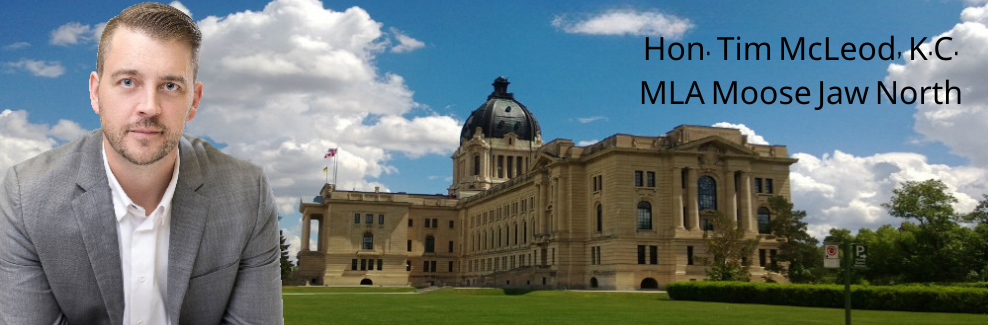
Bill 42 (The Saskatchewan Firearms Amendment Act, 2025)
Second Reading
From Hansard (26 November 2025)
To view this section on video, click here and start play at 2:37:35 PM.
Hon. Tim McLeod: — Thank you very much, Mr. Speaker. I now move second reading of The Saskatchewan Firearms Amendment Act, 2025.
Mr. Speaker, in 2023 this government passed The Saskatchewan Firearms Act to implement provincially based administration of licensing of legal firearms. That Act serves the dual functions of promoting public safety in Saskatchewan and administering firearms in a manner that protects the rights of lawful firearms owners. This bill further expands these two key functions of that Act.
First, the amendments provide legal firearms owners the right to fair compensation for lawfully owned firearms that have been rendered valueless because of the federal government’s recent firearms laws. Under these new rules, Mr. Speaker, a firearm is deemed to be seized by the federal government if the firearm is subject to the new federal firearms laws and the owner does not receive full fair-market compensation under the Act within 12 months after the federal law comes into effect.
If the firearm is deemed to be seized, the owner may submit a request for fair compensation based on fair-market value by the Saskatchewan firearms commissioner, and the Government of Canada is required to pay the owner the full fair-market value of the firearms. If the Government of Canada refuses to pay the fair-market compensation to the owner, the owner could choose to bring a claim against the federal government for recovery of that compensation.
Mr. Speaker, these compensation rules will apply to both handguns that were impacted by the former federal Bill C-21 as well as firearms that have been impacted by the federal orders in council in more recent years. In addition to providing fair compensation to owners, these compensation rules also serve an important public safety function by discouraging certain owners from turning to the illicit market to try and get value for their now-valueless firearms.
Second, the amendments made additional updates to enhance public safety. These changes include clarifying the Saskatchewan firearms office’s authority to inspect firearm ranges and designate firearm safety instructors, allowing medical professionals to report individuals who may suffer from a condition that makes it dangerous to possess or use a firearm, and finally by implementing other administrative updates to clarify the enforcement of the Act.
Saskatchewan has a strong tradition of promoting the safe and lawful use of firearms for activities such as hunting, sport shooting, and predator control. These amendments will build on those traditions and help Saskatchewan firearms office carry out its important functions.
With that, Mr. Speaker, I am pleased to move second reading of The Saskatchewan Firearms Amendment Act, 2025.
Standing Committee on Intergovernmental Affairs and Justice
From Hansard (10 March 2026)
To view this section on video, click here and start play at 4:50:20 PM.
Clause 1
Chair B. McLeod: — So we’re moving to consideration of Bill No. 42, and that is The Saskatchewan Firearms Amendment Act, 2025 beginning with clause 1, short title. Again you’ve heard the instructions in regards to the microphones. And we’ll ask that the first time you speak, you introduce yourself.
So, Minister McLeod, please make your opening comments.
Hon. Tim McLeod: — Thank you very much, Mr. Chair. Joining me at the table, to my right, I have Blaine Beaven, senior legal counsel with the Saskatchewan firearms office; and to my left, Neil Karkut, Crown counsel, legislative services. Also joining behind but in the room, we have Darcy McGovern, K.C., legal executive director with legislative services; and Stephen Coote, executive advisor to the Saskatchewan firearms office.
Mr. Chair, I am pleased to offer opening remarks for Bill 42, The Saskatchewan Firearms Amendment Act, 2025. This Act is about both public safety and recognizing the rights of Saskatchewan’s lawful firearms owners.
This bill contains two sets of amendments. First, the amendments provide legal firearm owners a right to fair compensation for lawfully owned firearms that are rendered valueless by the federal government’s recent firearms laws. Under these amendments, a firearm is deemed to be seized by the federal government if, firstly, the firearm is subject to the new federal firearms laws; and secondly, the owner does not receive full fair market value compensation under the Act within 12 months after the federal law comes into effect.
If the firearm is deemed to be seized, the owner may submit a request for valuation by the Saskatchewan firearms commissioner, and the Government of Canada is required to pay the owner the full fair market value of the firearms. If the Government of Canada refuses to pay fair market value compensation to the owner, the owner could choose to bring a claim against the Government of Canada for recovery of that compensation.
These compensation rules apply to handguns that were impacted by the former federal Bill C-21 and firearms that have been impacted by federal orders in council.
Mr. Chair, additional House amendments will also be moved today respecting these changes. Section 117.08 of the Criminal Code exempts individuals from certain federal firearms laws when they are acting on behalf of a provincial government. These House amendments allow Saskatchewan’s firearms commissioner to designate individuals who are acting on behalf of the Government of Saskatchewan for the purposes of section 117.08.
Under this change, owners who request a valuation by Saskatchewan’s commissioner may be authorized to store their firearm on behalf of the province until the completion of the evaluation process and until they have received fair compensation from the federal government. To be eligible for this process, owners will be required to comply with applicable firearm storage and safety laws.
By storing their firearms on behalf of the province, these owners will be acting directly on behalf of and for the benefit of the province. Under this approach, the Saskatchewan firearms office will avoid the requirement of collecting and storing these firearms in its own facilities pending compensation from the federal government.
In appropriate cases, the commissioner can use designations for other purposes such as designating qualified individuals to train ballistics laboratory staff to restore firearms serial numbers.
The second set of amendments make additional updates to enhance public safety. These changes include clarifying the Saskatchewan firearms office’s authority to inspect firearm ranges and designate firearm safety instructors, allowing medical professionals to report individuals who suffer from a condition that makes it dangerous to possess and use a firearm, and finally implementing other administrative updates to clarify the enforcement of the Act.
Mr. Chair, I’d now be pleased to answer any questions from the committee. Thank you.
Chair B. McLeod: — Thank you, Minister. I will now open the floor to questions. I recognize MLA Nicole Sarauer.
Nicole Sarauer: — Thank you, Mr. Chair, and thank you, Minister, for your opening remarks. I’m going to first ask a few questions about this House amendment, and then I’ll move on to what I see are three different topics that are being addressed in your initial bill, just for your understanding.
First of all, let’s talk about the amendment to section 2-2 that’s proposed in the House amendment. Could you explain to the committee whether or not you have received advice that this amendment is constitutionally compliant?
Hon. Tim McLeod: — I have. And I have the benefit of senior legal counsel with the Saskatchewan firearms office here joining at the table, and perhaps you want to speak to that.
Blaine Beaven: — Sure. Thank you. Blaine Beaven, senior legal counsel with the Saskatchewan firearms office. So we have discussed this matter with Justice, and of course including constitutional branch there, discussing it. And because it’s a provision of the Criminal Code that exists currently and it’s worded in accordance with what we have in the House amendment, this is really a designation amendment, designating who on behalf of the province can issue those exemptions. The power to issue those exemptions already exists within the Criminal Code, so we’re not . . . This identifies who can issue those exemptions, and then the regulations will identify for what purpose.
And the nature of . . . You know, when we determine specifically the wording of section 117.08 talks about “on behalf of,” when you look at the case law, that’s been interpreted to be “to the benefit of.” And that’s where we find the benefit in this case, where under the current proposal of how we’re dealing with the compensation program of storing firearms, that’s going to incur a cost to the province. This prevents that cost to the province. That’s the benefit to it.
Nicole Sarauer: — Is this a novel way of interpreting the provision based on the case law? Or has there been other examples where private individuals have been designated in this way under this Criminal Code provision?
Neil Karkut: — Neil Karkut, Ministry of Justice. I can’t speak to every instance where the designation or the 117.08 has been used by other jurisdictions, because that would involve I guess looking at every jurisdiction throughout the time that that provision has been in place. However we have reviewed this provision with our constitutional law branch and are confident that we would defend it if it was challenged on a constitutional basis.
Nicole Sarauer: — Thank you. I’m curious to know how this will operate effectively in terms of how this . . . if an individual, for example, is designated by the SFO [Saskatchewan firearms office] under this provision and they are able then to continue to store their firearm in their home location, how for example that will be communicated to police or any other sort of enforcement body that might be interested in that information.
Blaine Beaven: — Thank you. With regards to the question of how this will be in practice, so the exemption’s going to be an exemption that comes with conditions upon it. So certain things would have to occur, like the person has to be a licensed . . . to have a valid licence. They have to comply with all storage and safety laws. And they have to be seeking compensation. So the only difference from the current federal amnesty that exists is the requirement to be seeking compensation under the Act.
In terms of notification to police, that’s really going to come through . . . I mean, we’ll have some communication generally with SACP [Saskatchewan Association of Chiefs of Police] and police forces. But we’re not going to be providing notification for individuals, because every individual who’s affected by this is eligible for one of these exemptions. And it would be on the police if they wish to, say, seek a warrant for someone’s residence to confirm whether they would have this exemption or not.
Of course if someone was moving outside of simply storing one of these firearms and using them for criminal use, and the police wanted to get a warrant, this exemption wouldn’t apply. It doesn’t cover that type of behaviour. It only covers pure storage.
So it does protect individuals from, say, once the amnesty ends that they couldn’t have, for example, a warrant done on their house just because they owned one of these firearms, because they’re seeking compensation for it. And this would protect them from that.
Nicole Sarauer: — Thank you. Would individuals who fall under this be able to use those firearms still, or are they only able to store them?
Neil Karkut: — I can speak to that point. So 117.08 of the Criminal Code doesn’t speak to use of firearms. It speaks to possession and storage of firearms. So that’s what the designation would be applying to specifically.
Nicole Sarauer: — Thank you. I’m going to move on from the House amendment. But since we’re on this topic I’m going to flip over to division 5, “Deemed Seizure.” And we can talk about the other two, division 4 and 3, after we’ve had this conversation, if that’s all right with you.
Could you explain the process for how an individual receives payment for their firearm?
Neil Karkut: — I’ll start with the explanation, and then if there’s any gaps Mr. Beaven may want to step in to fill them in after.
I think the starting point would be to look at the Act as it exists at this point. Right now part 4 and part 5 specifically deal with the new federal firearms laws that, we refer to them . . . I think they’re called specified laws for the purposes of specified law under the Act.
Currently the Act says, that section in part 4, that if any individual or business is going to work to seize those firearms, first of all they have to be licensed by the province as a seizure agent and comply with certain requirements — storage requirements for example, and certain record-keeping requirements. Under part 5 it indicates that when . . . One of those seizure agents cannot destroy a firearm until they have provided proper fair market compensation in accordance with this Act. And at that point they would be providing a request to Saskatchewan’s firearms commissioner for that valuation.
Where these new amendments step in is that if the federal government — and we’re seeing that — doesn’t take any steps to actually get a seizure agent licence and conduct those seizures, legal firearms owners, their firearms are still rendered valueless. They have a legally purchased, legally owned firearm that now they are no longer able to transfer for value, and also they’re no longer able to use it under the federal laws, which amounts essentially to effectively an expropriation by the federal government.
Under these news rules what it is saying, that when you’re in that circumstance — that your firearm has been impacted by these new laws and the federal government hasn’t paid fair market compensation within a year — is that it’s deemed to be seized. And at that point the firearm owner themselves can submit a valuation process to the commissioner, and the commissioner will provide that fair market valuation to that firearm. And at that point the owner is entitled to receive that full valuation from the federal government.
There is also a clarification that if the federal government does not make that payment, there is a right for that firearms owner to bring legal action against the Government of Canada for that payment.
Nicole Sarauer: — I think you just answered my next question, and it was on section 5-14(2)(a). I was wondering on the enforcement of that. And I believe you just answered that should the Government of Canada not comply, then the individuals have the right to commence a legal action against the federal government. Is that correct?
Neil Karkut: — Yes, that’s correct.
Nicole Sarauer: — Thank you. Is there any obligation on the federal government to take the deemed fair market value as assessed by the SFO as fact?
Hon. Tim McLeod: — Thank you. So I think what I’ll do is I’ll ask Blaine in a moment to talk about the valuation process and how the use of the online portal will effectively assist any lawful property owners to arrive at that.
But the critical component I think is that here in Saskatchewan we want to use our experts to make sure that the Saskatchewan property owners and their lawful property are given the appropriate fair market value, and so that we are going to use experts through the Saskatchewan firearms office to arrive at that value that we believe is fair market value. And that will be done through the portal system that I’ll ask Blaine to elaborate on.
Blaine Beaven: — Sure. Thank you, Minister. The portal system is going to be an online application through the Saskatchewan website, and it’s going to allow people to go in and input their information that describes who they are and then input information about their firearms.
And what’ll happen is that information about the firearms . . . and not just firearms, but firearms and accessories that cannot be used for other firearms, so unique accessories or unique ammunition that cannot be used in another firearm that’s not prohibited. So things that have lost value will be captured, including descriptions, photographs, things of that nature.
And then that material in a blind basis, so that the individual is not identified, will be provided to our experts who have access to this portal, experts that are . . . They’re licensed by insurers and appraisers and they’re licensed as appraisers to look at these items and provide a fair market value to us, that we then return to the individual. We provide them with a certificate of value that says, your firearm has been evaluated, and your accessories, and here is the value of that item for their use.
Nicole Sarauer: — Thank you for that answer. I’m still left with my original question though as to whether or not the federal government is obligated to take the province’s appraisal of that firearm’s fair market value as fact. Could you provide an answer to that question?
Darcy McGovern: — Darcy McGovern. Just on a little broader basis in terms of what the question by the member was engaging, it’s a matter of property and civil rights. We view this as an expropriation procedure. And this is so that, like judgment enforcement, which the member will be well familiar with, or The Personal Property Security Act, we have an ability within that process to set out what the procedures are and what the requirements are with respect to that provincial process set out under the firearms Act. And so this is the initial valuation.
If the federal government on a case-by-case basis on an individual case wanted to take a position that the certificate of value was to be challenged or was high or, God forbid, low that they would suggest, then they would have the ability to do that. But that would be a straight up evidentiary matter on an individual basis.
But what we’re doing is establishing under the provincial jurisdiction the process for proceeding this way under this Act in Saskatchewan.
Nicole Sarauer: — My colleague just asked an interesting question to me that I don’t have the answer to so I’m hoping you will have the answer to, Minister. If somebody is compliant — they have been granted a designation under section 117.08 of the Criminal Code and they are currently storing their firearm in their home — if that individual for no fault of themselves has that firearm stolen from them, what happens? Are they still able to receive compensation? I’m assuming insurance wouldn’t cover that type of property theft.
Darcy McGovern: — So our initial reaction to that — and it’s an interesting question — would be that because it was legally held an insurance claim would be valid in that circumstance under your house pack, though I don’t want to speak to SGI’s [Saskatchewan Government Insurance] process. But it’s a legally held piece of property at that point that would have been stolen.
In terms of the third party compensation part of it, that would of course depend where you are in the process. But if you’ve got property stolen, it would be dealt with as any other stolen legal property at that point.
Hon. Tim McLeod: — If I can just elaborate on that a little bit, I think it speaks to the underlying point that what we’re doing with this legislation is protecting law-abiding citizens who are lawfully in possession of property. The rights of those individuals are being negatively impacted by the federal government. But it should not preclude them from their property rights to lawful property, lawfully obtained and lawfully held property.
Nicole Sarauer: — Sure. Absolutely agree with that. And we’re just making sure that there aren’t any gaps in that protection in this legislation.
On that, section 5-16 requires an owner to provide written notice of payment by the federal government to the commissioner. What happens if an owner is paid but doesn’t provide that written notice?
Blaine Beaven: — I would just say that I believe that it’s an offence. There’s an offence provision that applies to that. Yeah, so that’s covered off in there obviously because it says they “shall provide” that. So that’s covered off by that. And they would be subject to an offence under the Sask firearms Act.
Nicole Sarauer: — Thank you. I’m going to move backwards to division 3, which talks about inspection of shooting ranges and shooting clubs. Could you provide for the committee’s information how these inspections are currently occurring and why these provisions are needed?
Blaine Beaven: — So currently they’re working on consent, and they have been since the introduction of the Canadian Firearms Act. The Firearms Act Canada doesn’t provide any provision for the inspection of shooting clubs or shooting ranges. It only allows for inspection of homes or businesses, which shooting clubs and shooting ranges are not.
The reason this came about is, in my role as senior legal counsel I keep an eye on other cases across the country. And there have been — particularly out East — cases where ranges are getting conditions imposed on them or their certification is being affected by the firearms officer imposing different standards. And they’re pushing back and they’re saying, well, you don’t have the authority to do this, including the authority to inspect the range in the first place.
So right now in Saskatchewan people who want to hold a range let us come and inspect to make sure it conforms. But this ensures that in the event that society maybe gets more litigious, this covers us off that we are covered. And then it also just provides so everybody knows what the expectations are. And so we saw a gap in the federal legislation that’s existed for some time. And we were looking at this as a way to complete that to allow the CFO [Chief Firearms Officer] to do their job.
Nicole Sarauer: — Thank you. Do you have any knowledge of an approximation of how many shooting clubs and shooting ranges are operating in Saskatchewan right now?
Blaine Beaven: — I unfortunately didn’t come prepared with that number. That’s a number that we could provide to you in due course. We just want to make sure we’re accurate. But in speaking with Mr. Coote in our, you know, day-to-day operations, I believe the number is around 40 or more. But we don’t have the exact number off the top of our head.
Nicole Sarauer: — Okay, thank you. I was just looking for a general number. Don’t feel like you need to provide us with a specific number for the committee.
Blaine Beaven: — Okay, thank you for that. Thank you for that.
Nicole Sarauer: — Moving on to division 4, reporting by medical professional. This new amendment provides a medical professional to report to the commissioner if, in the opinion of the medical professional, the individual is suffering from a condition that makes it dangerous for the individual to possess and use a firearm. Could you explain to the committee what is currently in place to address this type of issue, and why this provision is needed?
Neil Karkut: — I can speak to that. Currently the Act has provisions for this in its regulations. And now that it’s come under review for amendment, we felt it was an appropriate time to shift these provisions into the Act to make them extra strong.
Nicole Sarauer: — Prior to it being added to the regulations, was there any conversation with respect to professional bodies of these medical professionals prior to its enactment?
Blaine Beaven: — Thank you. So after the Sask firearms Act was passed, we were actually contacted by the Sask Health Authority. And it was indicated to some of our firearms officers at the CFO office that medical professionals were concerned about their liability by providing information. And so at that point when we passed regulations, that was addressed in the regulations. And as Mr. Karkut said, it was a chance to just bring it into the Act, which is the more appropriate place to put it.
But it was from a concern raised by the SHA [Saskatchewan Health Authority] that we brought this into place. I mean medical professionals, like any member of the public, have the ability to report. But obviously they’re concerned about their liability if they do so, or being sued. And we wanted to provide that protection because, especially with mental health concerns, medical professionals have a unique insight into that, an opportunity to provide that information if they feel it’s a concern. So we wanted to make sure that that type of reporting wasn’t stymied.
Nicole Sarauer: — Thank you. Have any disclosures occurred since these provisions were put into the regulations?
Blaine Beaven: — I can’t speak to specifics. Obviously there’s personal information involved. And I don’t . . . I mean I could provide . . . I don’t have that information at my fingertips. I’d be amazed if there wasn’t, given the number of public safety complaints we receive on a regular basis. If you wanted a number of them or statistical, we could provide that. We could find that information and provide that, but it’s not explicitly tracked in that way.
Nicole Sarauer: — That’s okay. Just looking for general; don’t need specific. If you don’t have it readily available, that’s completely fine.
Blaine Beaven: — The other area this assists with is — we have had it in Saskatchewan and other jurisdictions — when the firearms officer requests medical information from a medical professional. Sometimes they will say, “I feel I’m going to be in trouble if I provide this to you.” And that can really foul up people’s licence applications and licence information for whatever reason. And so this provides I think some protection that medical professionals can be open and honest.
And I believe the firearms officers have been pointing to this when they’ve been making those requests, that it’s available. You know, it’s something you can do within the regulations without concern.
Nicole Sarauer: — Thank you. Can you explain to the committee what the Sask firearms office does or will do with the information if a disclosure occurs?
Blaine Beaven: — Certainly. So disclosure would come in, and it would be handled by the Chief Firearms Officer side, which deals with regulatory matters. And it would be investigated just like any other public safety complaint.
So if a concern is raised, you know, in an operational perspective, it’s assigned to a firearms officer, who then begins an investigation, which would include reviewing the report that was made; interviewing individuals; assessing whether an individual remains eligible; and if necessary, taking action to either revoke their licence, refuse their licence application, or implement provisions of the Criminal Code to seek an order to remove their firearms, a warrant to search. And we’ve done that in other cases not coming out of medical professional reports, but we’ve sought warrants and taken people’s firearms away where necessary.
Nicole Sarauer: — Thank you. No further questions.
Chair B. McLeod: — Seeing no more questions, we’re going to proceed to vote on the clauses. I’ll get myself ready. Clause no. 1, short title, is that agreed?
Some Hon. Members: — Agreed.
Chair B. McLeod: — Carried.
[Clause 1 agreed to.]
[Clauses 2 and 3 agreed to.]
Clause 4
Chair B. McLeod: — Clause no. 4. I recognize MLA Martens.
Hon. Jamie Martens: — Thanks. I would like to move an amendment, please:
Clause 4 of the printed Bill
Amend section 2-2 of The Saskatchewan Firearms Act, as being enacted by Clause 4 of the printed Bill, by adding the following subsection after subsection (4):
“(5) Subject to the regulations, the commissioner may, by order, designate individuals or classes of individuals who are acting on behalf of, and under the authority of, a department or ministry of the Government of Saskatchewan for the purposes of section 117.08 of the Criminal Code.”
Chair B. McLeod: — Thank you. MLA Martens has moved an amendment to clause 4. Would any members like to speak to the amendment? Seeing none, do committee members agree with the amendment as read?
Some Hon. Members: — Agreed.
Chair B. McLeod: — Carried. So is clause 4 as amended agreed?
Some Hon. Members: — Agreed.
Chair B. McLeod: — Carried.
[Clause 4 as amended agreed to.]
[Clauses 5 to 14 inclusive agreed to.]
Chair B. McLeod: — Clause 15, is that agreed?
Some Hon. Members: — No.
Chair B. McLeod: — I hear a no, so I will be calling for a voice vote, and I would like to inform committee members that I will be exercising my right to deliver the vote. So all those in favour of clause 15 as written say aye.
All those opposed to clause 15 as written say no.
Some Hon. Members: — No.
Chair B. McLeod: — So I believe I heard nos, and the nos have it. Clause 15 is not agreed. This clause is defeated.
[Clause 15 not agreed to.]
Chair B. McLeod: — Clause 16, coming into force, is that agreed?
Some Hon. Members: — Agreed.
Chair B. McLeod: — Carried.
[Clause 16 agreed to.]
Chair B. McLeod: — I recognize MLA Martens.
Clause 15
Hon. Jamie Martens: — Yes. Chair, I would like to move a new clause.
Chair B. McLeod: — Please go ahead.
Hon. Jamie Martens: — And the new clause would be:
New Clause 15 of the printed Bill
Add the following Clause after Clause 14 of the printed Bill:
“Section 6-9 amended
15 Section 6-9 is amended:
(a) by adding the following clause after clause (b):
“(b.1) respecting designation orders by the commissioner pursuant to subsection 2-2(5)”;
(b) by adding the following clauses after clause (e):
“(e.1) respecting the inspection of shooting clubs or shooting ranges pursuant to Division 3 of Part 3;
“(e.2) prescribing other categories of medical professionals for the purpose of section 3-21;
“(e.3) for the purposes of Division 5 of Part 3:
(i) respecting the designation of instructors; and
(ii) prescribing rules or requirements for instructors”; and
(c) by adding the following clauses after clause (k):
“(k.1) respecting deemed seizures for the purposes of sections 5-14, including:
(i) prescribing any form, process or procedure for the purposes of that section;
(ii) exempting any person or firearm from the application of that section;
(iii) respecting the coming into force of specified laws; and
(iv) respecting the determination of fair market value for the purposes of that section;
“(k.2) respecting the storage and testing of firearms by the commissioner for the purposes of section 5-15;
“(k.3) respecting the destruction or deactivation of a firearm for the purposes of section 5-16”.
Chair B. McLeod: — I would just say that was well read. Thank you. So MLA Martens has moved new clause 15, and there’ll be an opportunity now for any member that would like to speak to the new clause.
Seeing none, do committee members agree with the amendment as read?
Some Hon. Members: — Agreed.
Chair B. McLeod: — Carried. So now we have new clause 15, is that agreed?
Some Hon. Members: — Agreed.
Chair B. McLeod: — Carried.
[Clause 15 agreed to.]
Chair B. McLeod: — A little extra paperwork there. His Majesty, by and with the advice and consent of the Legislative Assembly of Saskatchewan, enacts as follows: The Saskatchewan Firearms Amendment Act, 2025.
I would ask a member to move that we report Bill No. 42, The Saskatchewan Firearms Amendment Act, 2025, with amendment. MLA Martens moves. Is that agreed?
Some Hon. Members: — Agreed.
Chair B. McLeod: — Carried. That brings us to a close. So I just want to express my thanks to everyone gathered here today, especially those that came in a capacity to help us with understanding. And I appreciate so much the wisdom that you provided and thank you for attending and being part of this committee meeting.
So any closing comments from the minister?
Hon. Tim McLeod: — Thank you, Mr. Chair. I would just like to echo your thanks to the officials who have brought so much information and wisdom to the committee meeting as you had indicated, the officers at the table with me, seated behind me. And also I’d be remiss not to thank our Saskatchewan firearms commissioner, Robert Freberg, who has done just diligent work on this matter and continues to advocate for Saskatchewan firearms owners. So I want to thank Mr. Freberg as well.
Thank you to yourself, Mr. Chair, and to the committee for the thoughtful questions. Thank you to the Clerks and Hansard for working into what is now the dinner hour. We greatly appreciate everyone’s attendance and participation this evening.
Chair B. McLeod: — Thank you. Closing comments from members?
Nicole Sarauer: — Yes, thank you. I’d like to join with yourself, Mr. Chair, as well as the minister in thanking first of all the officials who came here this evening. Thank you for thoughtfully answering all of my questions. To yourself, Minister, for the same; I very much appreciate it. To the committee for being here as well as to broadcast services: thank you for your work. And Hansard and the staff that work with us every single day.
Chair B. McLeod: — Thank you so much, MLA Sarauer. I was going to add our Hansard operator. You’ve beat me to it, and I’m glad you did. That’s awesome. I appreciate it.
So this concludes our business for today. I would ask a member to move a motion of adjournment. MLA Crassweller has moved. All agreed?
Some Hon. Members: — Agreed.
Chair B. McLeod: — Carried. This committee stands adjourned to the call of the Chair. Thank you so much.
Back to 2025/2026 Session

Constituency Office
Constituency Assistant: Jacqui Stephens
200 – 99 Diefenbaker Drive
Moose Jaw, SK S6J 0C
Telephone: (306)-692-8884
Fax: (306)-693-3251
Email: mjnorthmla@sasktel.net
Hours of Operation:
Monday to Friday from 8:30 to 12:00 and 12:30 to 4:00